
/ 4 min read
Fragments of the Sky: Xerjoff and the Meteorite in a Bottle
There is a particular kind of longing that has nothing to do with the earth. It is the feeling you get on a clear night, tilting your head back until the vertigo comes, aware for a brief second of how impossibly old and far the light above you truly is. Perfumery rarely reaches for that feeling. It is fluent in gardens, in leather and smoke and skin — the vocabulary of the ground beneath us. But one house has spent years trying to bottle the other direction entirely: up.
The story begins, fittingly, in a museum. Xerjoff’s founder Sergio Momo was walking through the Natural History Museum in London when he encountered the tale of the Sikhote-Alin meteorite — a mass of iron that tore through the sky over eastern Siberia in 1947, one of the largest witnessed falls in recorded history. Something about the object caught him: not the violence of its arrival, but its impossible provenance. Here was matter older than the planet, a traveller that had drifted for billions of years before landing, by pure chance, close enough to touch. From that encounter grew Shooting Stars, a collection whose perfumes are named, one after another, for the meteorites that have fallen to us.
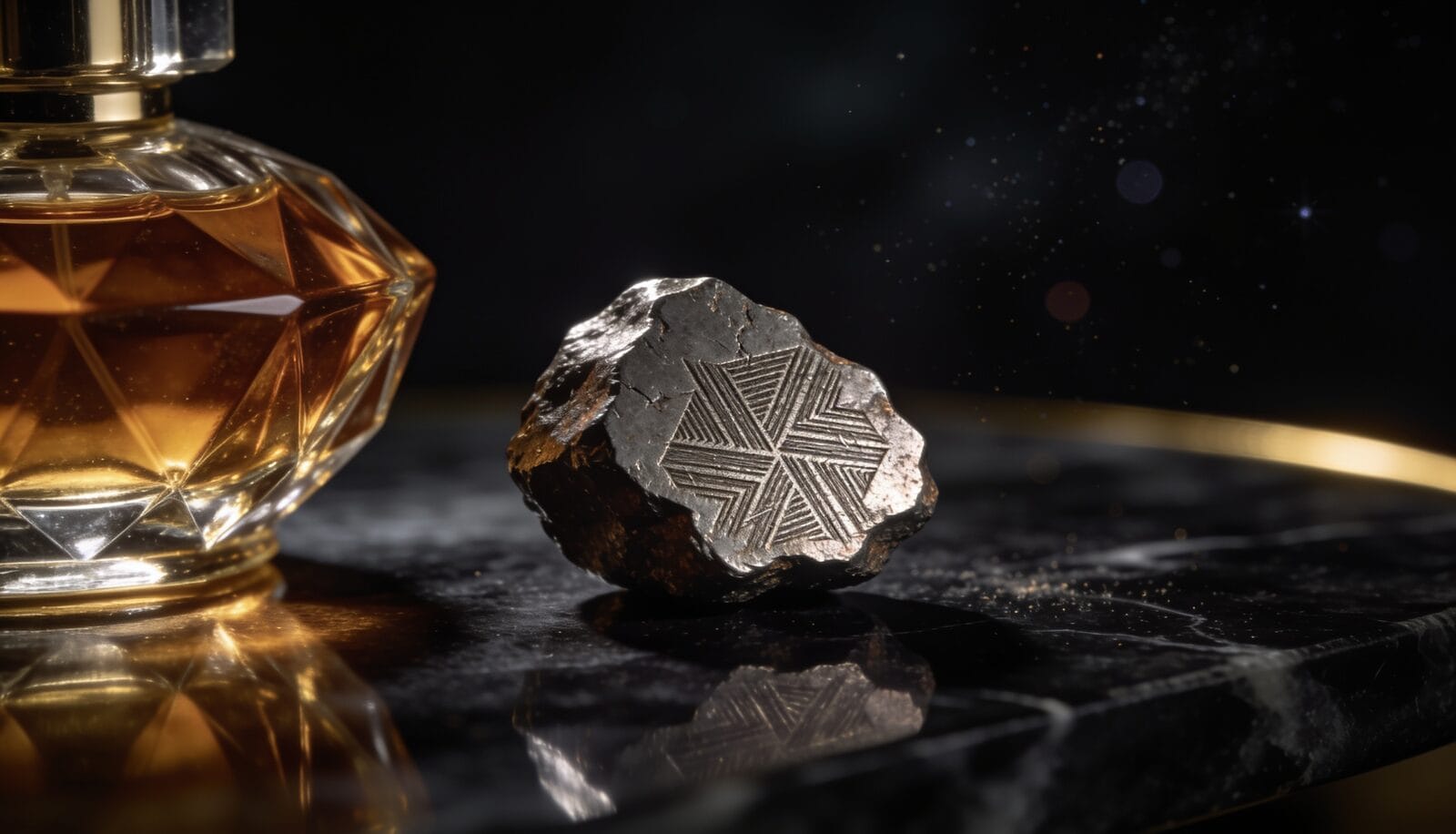
The newest of them is Gibeon, and its namesake carries one of the most beautiful backstories in the whole catalogue of things that have fallen from space. The Gibeon meteorite is a rare iron mass that crashed in prehistoric times across what is now Namibia, scattering fragments over the Kalahari. Etch its surface and it reveals Widmanstätten patterns — interlocking crystalline geometries that can only form during a cooling so slow it takes millions of years, a structure quite literally impossible to reproduce on earth. Western science did not formally document it until 1836, but long before that the Nama people had been working the iron by hand, forging spearheads and tools from a metal that had arrived, silently, from the stars. To wear a fragrance named for it is to stand inside that long chain of human wonder.
And the scent itself refuses the obvious. There is no gunmetal, no cold mineral trick to signal “space.” Gibeon opens instead with the soft, powdery hush of neroli, an airy ozonic clarity drifting over it like high, thin atmosphere. At its heart sits Tuscan orris — that most patient and aristocratic of materials, all suede and violet and cool grey light — lending the composition a velvety, almost weightless caress. The descent is warm and dreamlike: Madagascan vanilla and tonka bean folding into clean musk and the balsamic softness of cedarwood. The effect is not extraterrestrial so much as luminous, a scent that feels lit from within, like the last minutes of dusk before the first star appears.
What elevates the Shooting Stars idea from clever concept to genuine talisman is what waits inside the coffret. Nestled within each ornate box is a certified fragment of meteorite — an actual piece of the solar system, born in the same ancient furnace as the sun, handed to you along with the bottle. It is a quietly staggering gesture. Most luxury asks you to believe in a story; this one puts the proof in your palm, cold and heavy and older than everything you have ever known. The perfume becomes the scent of an object you can hold, and the object becomes a reason to keep the perfume forever.
It is no accident that this reaches us now. We are living through a cultural tilt back toward the celestial — a hunger for scale and silence and wonder, for anything that reminds us the world is larger than the screen in our hand. Where niche perfumery spent recent seasons chasing the intimate and the tactile, the skin-close and the barely-there, Gibeon points the other way: outward, upward, toward the sublime. It offers escape not into softness but into vastness, the particular luxury of feeling small in the best possible sense.
Xerjoff calls the collection “fragments of the sky in a bottle,” and for once the marketing is simply true. To wear one is to carry a contradiction gracefully — something unimaginably distant made briefly, warmly personal; the coldest reaches of space rendered as a caress at the wrist. In a category that so often looks down at the earth for its beauty, here is a house that dared to look up. The result is not a perfume that shouts across a room. It is one that waits, like starlight, for you to notice how far it has come to reach you.
Before You Commit
Read about it. Then live with it.
Order a 2ml decant of any scent in the house and wear it for a few days before you commit.