/ 3 min read
Suede: The Leather That Learned to Whisper
Some notes you smell. Suede you almost feel. Before the brain names a single ingredient, the skin seems to register a surface — matte, brushed, faintly warm, the nap of a glove worn soft by years. It is one of perfumery's most seductive illusions, because there is no such thing as a suede flower, a suede resin, or a suede oil. Suede does not exist in nature at all. It is conjured — a texture translated into scent by a perfumer who has decided that leather should, for once, lower its voice.
To understand suede you have to remember what leather used to be. The great leathers of the last century were acts of bravado: the tarry, campfire bite of birch tar in a Russian leather, the bitter green snarl of isobutyl quinoline in Bandit, smoke and animal and danger worn like armour. They announced themselves from across a room. Suede is what happens when all of that rawness is sanded down — the smoke dimmed to an ember, the animal softened to skin, the edges brushed until what remains is not a hide but the memory of touching one.
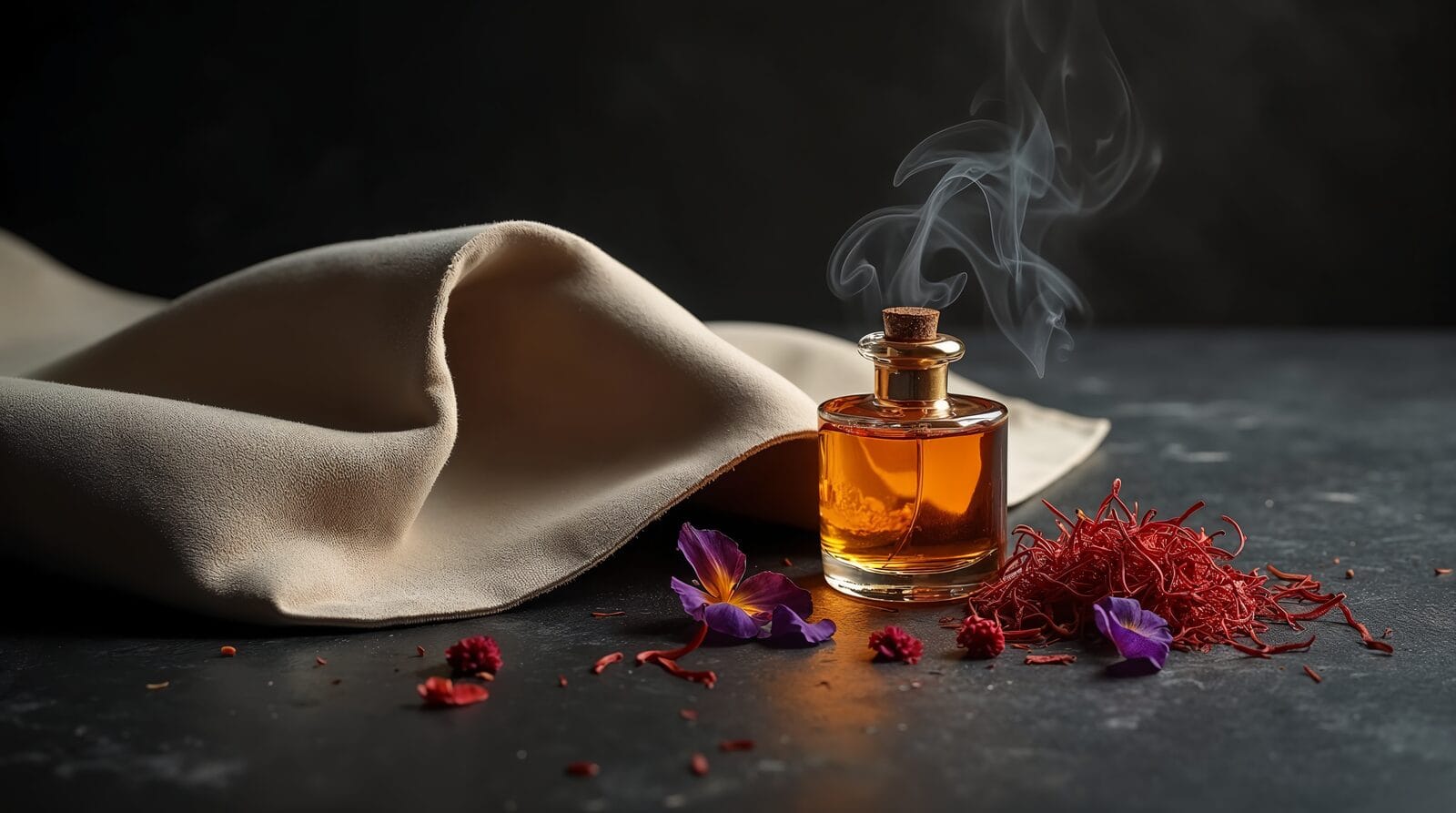
The modern suede accord is a quiet feat of construction. Its secret heart is saffron — not the kitchen spice so much as its leathery, faintly sweet facet, amplified by captive materials like Safraleine that glow with a warm, suede-like radiance. Around it perfumers lay powder: the orris-and-violet softness of the ionones, which give that characteristic velvety nap, the sense of a surface you could run a thumb across. Soft white musks blur the whole thing into skin. A restrained whisper of styrax or birch is allowed to remain, just enough to remind you that this was, once, leather. The result reads not as an object but as a sensation.
The canon is small and beloved. Serge Lutens and Christopher Sheldrake set the standard in 2004 with Daim Blond — daim is French for suede — folding apricot, iris and heliotrope into a powder so tender it feels less like perfume than cashmere against the throat. Bottega Veneta built an entire house signature on the smell of a fine leather atelier. And for contrast there is Tom Ford's Tuscan Leather, suede's loud, raspberry-bloodied cousin: proof of how far a single family can travel from whisper to roar.
What makes suede the note of this moment is a shift the whole craft is living through. The conversation in niche perfumery has turned, decisively, from projection to texture — away from the sillage monsters that fill a lobby and toward fragrances you wear for the person close enough to touch you. At Esxence 2026, the Milan gathering that sets the year's direction, the most-discussed debuts were not the loudest but the most tactile: salty fruits, transparent woods, and above all soft, brushed leathers.
Amouage made the point most eloquently. In June the house added Suede Ibri to its Attars collection, a composition by Théo Belmas built on saffron, leather and violet — the classic suede triangle — kept deliberately soft, powdery and shadowed with smoke, and designed to be pressed into the skin rather than sprayed into the air. It is perfume as ritual and as intimacy: a scent that rewards closeness instead of demanding distance.
Perhaps that is why suede feels so right just now. We have learned to prize the quiet luxuries — the unlined jacket, the cashmere worn thin, the things whose richness you only understand when you are near them. Suede is their scent: not the armour of leather but its softness, the warmth of a surface that asks to be touched. Wear it and you are not filling a room. You are offering something to whoever leans in close — which has always been the more generous, and the more seductive, thing to do.
Before You Commit
Read about it. Then live with it.
Order a 2ml decant of any scent in the house and wear it for a few days before you commit.