/ 4 min read
Solar: The Art of Bottling Sunlight
There is a smell almost everyone recognises and almost no one can name. It is the scent of a warm shoulder at the end of a long afternoon, of skin that has held the sun all day and given a little of it back. It is creamy and golden and faintly sweet, with something powdery underneath like the memory of suncream carried on a sea breeze. Perfumers call this register solar, and for all its apparent simplicity it is one of the most quietly sophisticated effects in the art — a way of bottling not a flower or a wood, but a feeling: light itself, warm on the body.
The first thing to understand about a solar note is that there is no such flower. Solar is not a raw material you can distil from a field; it is a construct, an accord built deliberately to evoke the sensation of sunlight, radiant warmth, and luminous air. A perfumer assembles it the way a painter mixes a colour that does not exist in the tube — by layering several materials until the eye, or the nose, reads a single impression. Get the proportions right and the result is unmistakable: you do not smell the parts, you simply feel the heat.
At the heart of the accord sit the salicylates — a family of molecules with a particular gift for warmth. Benzyl salicylate is the most evocative of them, faintly sweet, slightly powdery, and unmistakably suntan-lotion in profile. It is the molecule most of us privately file under summer without ever knowing its name. Octyl salicylate works alongside it, smoothing and extending that glow. Together they give a composition its low golden hum, the olfactory equivalent of light pooling on skin.
The salicylates carry a story that explains the whole genre. The brand Ambre Solaire originally used benzyl salicylate not for its scent at all, but as a working ingredient — an early ultraviolet filter that helped its suncream do its job. Over the years the chemistry was reformulated, yet the molecule was deliberately put back, no longer to block the sun but purely for the way it smelled. By then a generation had learned to read that faintly sweet warmth as summer itself; the scent had outgrown its function and become a memory worth preserving. There is no clearer proof that, in solar perfumery, we are not chasing a material so much as chasing a feeling we have all already lived.
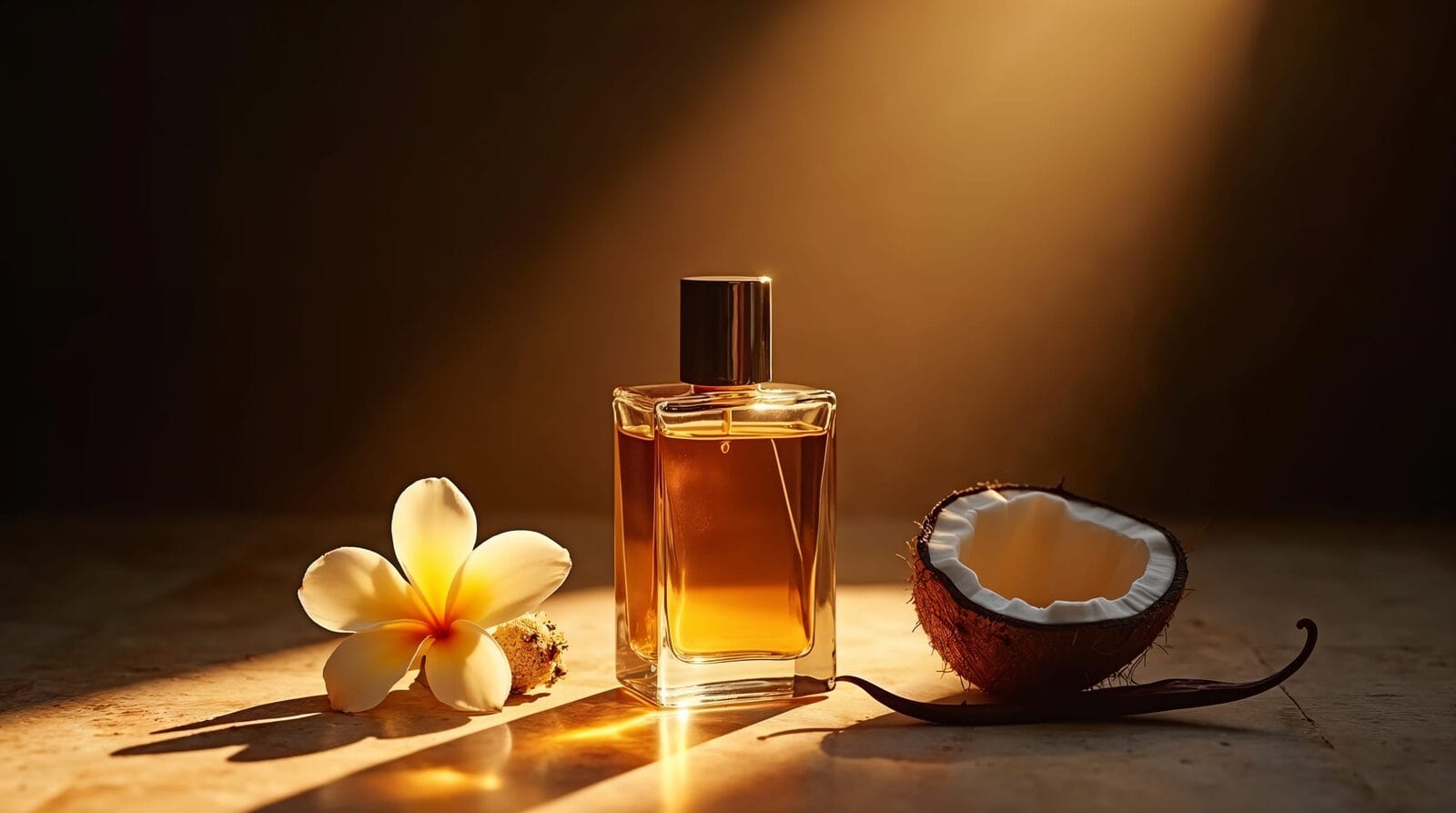
Around that warm core the perfumer arranges the creamy white flowers — the lactonic, almost edible blooms that smell of milk and petals at once. Tiare and frangipani bring the unmistakable air of the tropics; ylang-ylang adds a carnal, sunlit richness reminiscent of monoi oil warming on bare arms; orange blossom lends a luminous sweetness, and a whisper of coconut rounds it all into something you could almost taste. A breath of clean musk settles the whole thing onto the skin, so that the effect is not a bouquet held at arm's length but a warmth that seems to rise from the wearer.
It would be easy to dismiss all of this as holiday perfume, pleasant and disposable — and for years much of the mainstream treated it that way. What makes the solstice of 2026 feel different is that the niche houses have come to the genre on their own terms. The defining movement of the moment is a turn away from loud projection and towards texture: skin scents, soft musks, transparent woods, waxy florals — fragrances meant to be discovered up close rather than announced across a room. Solar belongs naturally to that conversation. Reframed as intimacy rather than spectacle, it stops being the smell of the beach and becomes the smell of the person who has just come back from it.
That is the quiet luxury of a well-made solar fragrance. It does not shout summer; it remembers it. It works on the same principle as the best photographs of light — not by depicting the sun, but by showing what the sun does to everything it touches. Worn well, it lends the body a kind of permanent late afternoon, a warmth that follows you indoors and lingers after the season has gone.
So as the longest days arrive and the light turns long and golden, it is worth reconsidering a register too often left on the shelf with the sunscreen. The finest solar perfumes are not souvenirs of a holiday. They are a way of carrying the best hour of the day on your skin all year — and, this summer, the most thoughtful houses in perfumery have finally decided it deserves their full attention.
Before You Commit
Read about it. Then live with it.
Order a 2ml decant of any scent in the house and wear it for a few days before you commit.