/ 3 min read
Santal: The Quiet Empire of Sandalwood
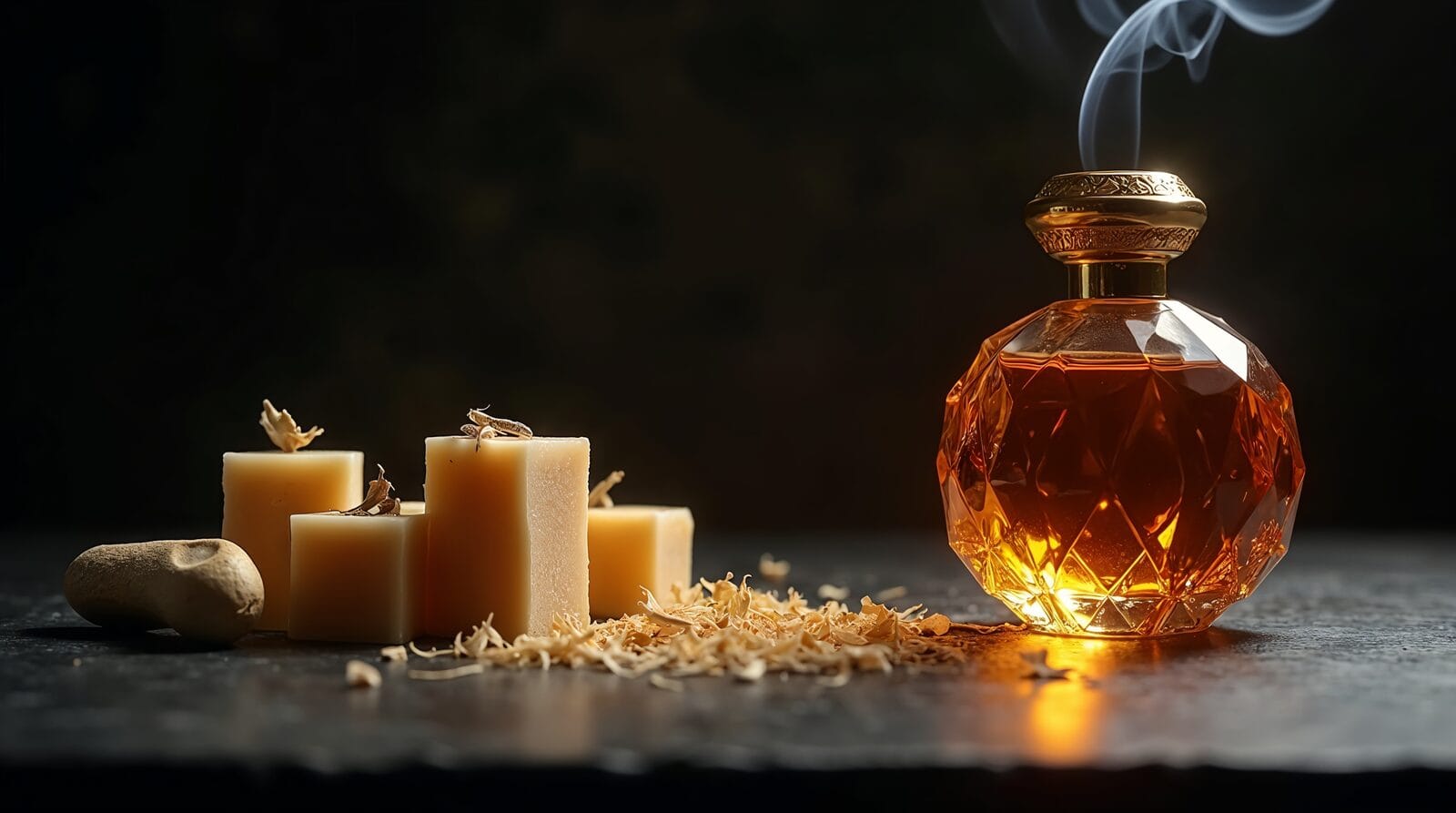
Some materials in perfumery arrive with trumpets. Sandalwood does the opposite. It steps in close, warm and faintly milky, and simply waits for you to lean toward it. The French call it santal, and the word has come to mean a particular kind of comfort: a wood that behaves like skin, creamy and rounded, never sharp. In 2026, after years of louder fashions, that quiet has become the most coveted sound in scent.
The gold standard has a name and a place. Mysore sandalwood—Santalum album grown in the red laterite soils around Karnataka, in southern India—remains the most revered wood a perfumer can hold. Its magic is largely chemical: an unusually high concentration of santalol, the molecule responsible for that buttery, lactonic warmth, reaching as much as ninety percent in the finest heartwood. That richness is why a single kilogram of true Mysore oil can command anywhere from roughly nineteen hundred to nearly five thousand euros, and why most of us will only ever meet it in trace amounts.
Such desirability nearly destroyed it. Santalum album was harvested so relentlessly that the wild Indian trees were pushed to the edge of extinction, and the Indian government eventually clamped down with strict export restrictions to protect what remained. For a time it looked as though the creamiest wood in the perfumer's palette might simply price and regulate itself out of reach—a heritage material slipping quietly into memory.
What saved it was patience and a change of address. Australia, with terrain and climate close enough to India's, began cultivating Santalum album on plantations—the same prized species, now grown sustainably and traceably rather than stripped from the wild. Alongside it grows the native Australian species, Santalum spicatum: drier, greener, less opulent, with santalol levels closer to twenty or forty percent, but honest and affordable at a fraction of Mysore's price. Australian groves now supply well over two hundred tonnes a year under strict sustainability standards, and trees reach harvest in ten to fifteen years rather than the decades old-growth forests once demanded.
This is not merely an agricultural footnote; it has quietly reshaped what sandalwood means on the skin. The new plantation woods are cleaner, more transparent, less smoky than the dense Mysore of legend—and that lighter touch happens to be exactly what this moment wants. The defining trend of 2026 is a turn away from projection and toward texture: skin scents, soft musks, transparent woods, the feeling of a fragrance rather than its volume. Sandalwood, creamy and close by nature, is the material that trend was waiting for.
You can trace its empire across the niche shelf. Le Labo's Santal 33 turned a leathery, smoky sandalwood into a cult uniform and, almost single-handedly, made “santal” a category. Diptyque's Tam Dao offers the gentler reading—milky, meditative, the wood as quiet ritual. Hermès folds it into the silk of Santal Massoïa, while houses like Matière Première build entire compositions around responsibly sourced Australian sandalwood, proving that sustainability and sensuality need not be at odds. Each is a different dialect of the same warm language.
Part of sandalwood's pull is that it has always been more than a smell. For centuries it has been carved into temples, ground into sacred paste, and burned to carry prayers upward. To wear it is to borrow a little of that gravity—a note that feels devotional even on an ordinary Tuesday. It does not seduce by force. It seduces by proximity, by the way it seems to rise from your own warmth rather than sit on top of it.
That is the real story of santal in 2026: a material that nearly vanished, learned to grow somewhere new, and emerged matched perfectly to a quieter age. The smoky grandeur of old Mysore will always be the dream, the reference, the thing collectors chase. But the future of sandalwood is being written in sustainable groves and weightless modern woods—proof that the most enduring luxuries are often the ones that whisper.
Before You Commit
Read about it. Then live with it.
Order a 2ml decant of any scent in the house and wear it for a few days before you commit.