/ 4 min read
Married in the Still: The Quiet Craft of Co-Distillation
There is a moment inside every great perfume that no formula can quite explain — the point where two ingredients stop behaving like neighbours and begin to feel like one. For most of modern perfumery, that marriage has been arranged on the perfumer's bench, drop by careful drop, after each material was born alone. But a quieter method is gaining ground, one that asks a more intimate question: what if two ingredients were never apart to begin with?
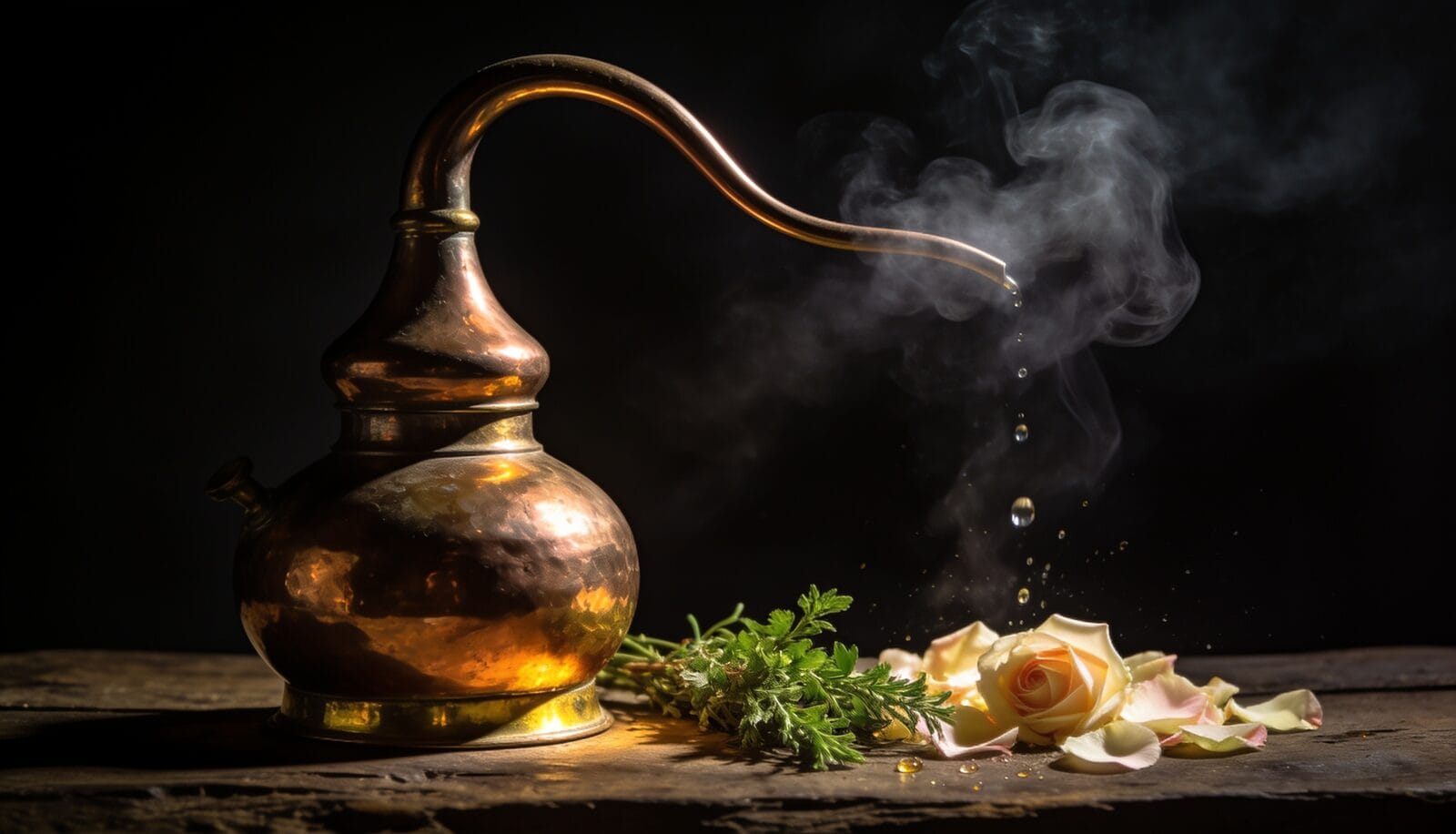
This is the promise of co-distillation. Instead of extracting rose and, separately, a green herb, then blending the two finished oils, the raw botanicals are placed together in the same still and distilled as one. Their volatile molecules rise, mingle, and condense side by side, so that what drips from the alembic is not a mixture but a single new material — an accord that existed at the source rather than after it. The result carries a seamlessness that blending struggles to imitate, a wholeness you sense before you can name it.
The technique moved from workshop curiosity to headline news this spring, when Robertet — one of the oldest houses in the world for natural raw materials — made it the centrepiece of its presentation at Paris Perfume Week. Alongside co-distillation, the maison staged a manifesto of what it called artistic upcycling: by-products and botanical "waste" transformed, as the house put it, into emotion and texture. In a saturated market where the same captive molecules circulate through a thousand launches, Robertet's argument was disarmingly simple — the surest way to smell unlike anyone else is to build ingredients no one else can copy.
That is the strategic heart of the moment. A co-distilled natural is, almost by definition, a signature: its character depends on the exact pairing, the ratio, the water, the heat, the hands that ran the still that day. It cannot be reverse-engineered from a gas chromatograph the way a single molecule can. For niche houses hungry for something genuinely their own, that irreproducibility is not a flaw but the entire point — a return to the idea that a scent should belong to someone.
It also answers a shift in the people who wear these perfumes. The connoisseur of 2026 is more ingredient-conscious than ever, curious not only about what a fragrance smells like but about how it came to be. Upcycling speaks to that conscience directly: the peel left after a citrus is juiced, the wood shavings from a mill, the spent botanicals of another extraction — all of it can be coaxed back into fragrance rather than discarded. What was once refuse becomes, in the right still, a top note. There is something quietly moving in a luxury built not on excess but on nothing wasted.
None of this is a rejection of the perfumer's art; it is an expansion of the palette they paint from. Co-distillation does not compose the finished perfume — it simply hands the artist a colour that has never existed before, a green that already remembers the rose it grew beside, a spice that arrives pre-warmed by the resin it was distilled with. The composition still happens on the bench. But the bench now begins somewhere richer.
For the wearer, the difference is felt rather than explained. Co-distilled materials tend to sit closer to the skin, less like separate voices in a chord and more like a single breath. They blur the seams a perfume usually reveals over hours, so that top, heart, and base feel less like acts in a play and more like weather — continuous, atmospheric, alive. It is the olfactory equivalent of a painting whose brushstrokes you cannot find.
What makes the technique so quietly thrilling is that it is not new at all. Distillers have married botanicals in the still for centuries; what is new is the intention — the decision to treat the still not as a factory but as a place where meetings happen, where two ordinary things become one extraordinary thing that neither could have been alone. In an industry forever chasing the next molecule, there is something profound in a house looking instead at the oldest copper vessel in the room and asking it to fall in love.
Before You Commit
Read about it. Then live with it.
Order a 2ml decant of any scent in the house and wear it for a few days before you commit.